Blogs
What does HMRC's new guidance require of UK estate agents?

UK estate agents must check who their buyers and sellers are, confirm where their money comes from and report anything suspicious. This comes from HMRC's AMLG2200 guidance for Estate Agent Businesses (EABs), issued under the Money Laundering, Terrorist Financing and Transfer of Funds (Information on the Payer) Regulations 2017 (MLR 2017).
The scope is wide. If a business buys, sells, markets or sources UK property, it's likely covered, including online only agents, property sourcers and auctioneers. The good news is that none of this needs to slow a sale down. APLYiD automates identity, source of funds and screening checks, so agents get compliance done in minutes rather than days and keep deals on track.
What is AMLG2200 and who has to follow it?
AMLG2200 is HMRC's Anti Money Laundering guidance for Estate Agent Businesses, sitting under MLR 2017. HMRC supervises EABs directly, so estate agents register with HMRC rather than a separate property body.
The guidance covers any firm or sole trader doing estate agency work, as defined in the Estate Agent Act 1979. HMRC is clear that online only businesses, with no physical premises at all, are still in scope. Property sourcing platforms, deal packagers, and investment brokers get the same treatment as high street agents.
What counts as "estate agency work" under UK law?
The definition covers far more than the final sale. It includes buying or selling freehold or leasehold property (commercial and agricultural too), sending property details and arranging viewings, advising a buyer or seller, acting as intermediary between the two, "for sale" boards, property sourcing, deal packaging, investment brokering, buying property for resale, selling developer owned property, auctioneering, relocation services, and even competitions where the prize is a property. Any business doing this needs to register with HMRC and run due diligence.
A shorter list sits outside the rules: private sales with no third party, pure advertising, platforms that connect buyer and seller with no advice given, solicitor led conveyancing in England and Wales, Scottish solicitors' property centres, independent property management, planning work, activity entirely outside the UK, mortgage arranging, and Scottish home reports. Advertising providers that only pass on seller details and use unbranded boards are also exempt, unless they do other estate agency work too.
When does customer due diligence need to happen?
Once a business is an estate agency business, it must identify and verify every party to a transaction, under Regulation 28 and Regulation 30 of MLR 2017. Verification has to happen before the business relationship starts, and HMRC recommends starting checks from first contact rather than leaving them until the end. This applies even to existing customers, unless they've already been verified properly.
For shared ownership properties, every owner needs checking, not just the lead name. If someone acts on a customer's behalf, like a solicitor or buying agent, the estate agent needs to identify and verify them too, and confirm their HMRC registration if they're an EAB themselves. Agents can rely on another regulated business's checks through a formal reliance agreement (more on that in the guidance).
Exactly when does an offer trigger the identity check?
Timing depends on who you're checking, and it's one of the most missed parts of this guidance.
For a buyer, checks need to be done by exchange of contracts. For a seller, before marketing starts, when they sign with the agent. For a property sourcing customer, at the point of instruction. For an auctioneer, the seller's checks are due at the listing agreement, and the buyer's before the contract becomes binding, using pre-registration or a condition precedent.
Knowing these dates upfront means checks stay ahead of the deal, not chasing it.
What extra checks apply to cash buyers or unusual funding?
Higher risk deals need enhanced due diligence (EDD), covering both source of wealth (how someone built their money overall) and source of funds (where this specific payment is coming from). HMRC suggests agents ask: has the funding source changed mid transaction, does the amount match the customer's known income, and can the agent show its reasoning for proceeding. Cash buyers are called out specifically as higher risk.
This isn't guesswork. HMRC's National Risk Assessment 2025 rates money laundering risk in UK real estate as medium, and terrorist financing risk as low. Estate agencies also need to weigh proliferation financing risk, with HMRC flagging higher risk on transactions linked to countries including North Korea and Iran.
What happens if an estate agent cannot complete the required checks?
If an estate agent can't complete the required checks, it can't process the transaction through the customer's bank account, can't start a relationship with them another way either, and needs to end any existing relationship where checks are incomplete. It also needs to consider whether a Suspicious Activity Report (SAR) is required. Get the checks running early, and this stays a background step rather than a late stage hold up.
What are an estate agent's suspicious activity reporting duties?
Every estate agent has its own legal duty to file a suspicious activity report when it suspects money laundering or terrorist financing, whether or not the deal goes ahead. HMRC is clear: don't assume someone else on the deal, a solicitor or bank, will report it instead. Multiple suspicious activity reports on one transaction are fine. Nobody reporting isn't. This duty covers the whole business too, so a property management arm raising a concern still counts.
How long must an estate agent keep AML records, and what about branches or franchises?
Records need to be kept for five years after the business relationship ends, then deleted. A property transaction counts as a business relationship from first instruction through to completion, withdrawal, or cancellation, and the five-year clock starts there.
Registration works by structure. Beneficial owners, officers, and relevant managers go through HMRC approval, and a business can start trading once its application is in. Any new branch needs notifying within 30 days of opening. If a principal firm controls an agent's activities and financial crime controls, that principal registers the agent's premises and owns their compliance. A franchisee with genuine operational independence registers separately, directly with HMRC.
How does APLYiD help estate agents meet the guidance requirements?
APLYiD replaces the manual chase for passports and supporting documents with one guided process. Buyers and sellers submit their documents, biometric checks confirm who they are (94% success rate, under 90 seconds), and Politically Exposed Person and sanctions screening run automatically in the background, right into the enhanced due diligence HMRC expects for cash buyers and higher risk deals.
Everything sits in one dashboard, giving the agency a live view of every client's compliance status. Decisions on source of funds and source of wealth get made and documented as the deal moves, not pieced together afterwards. Checks keep running for the life of the transaction, with automated alerts on anything that changes.
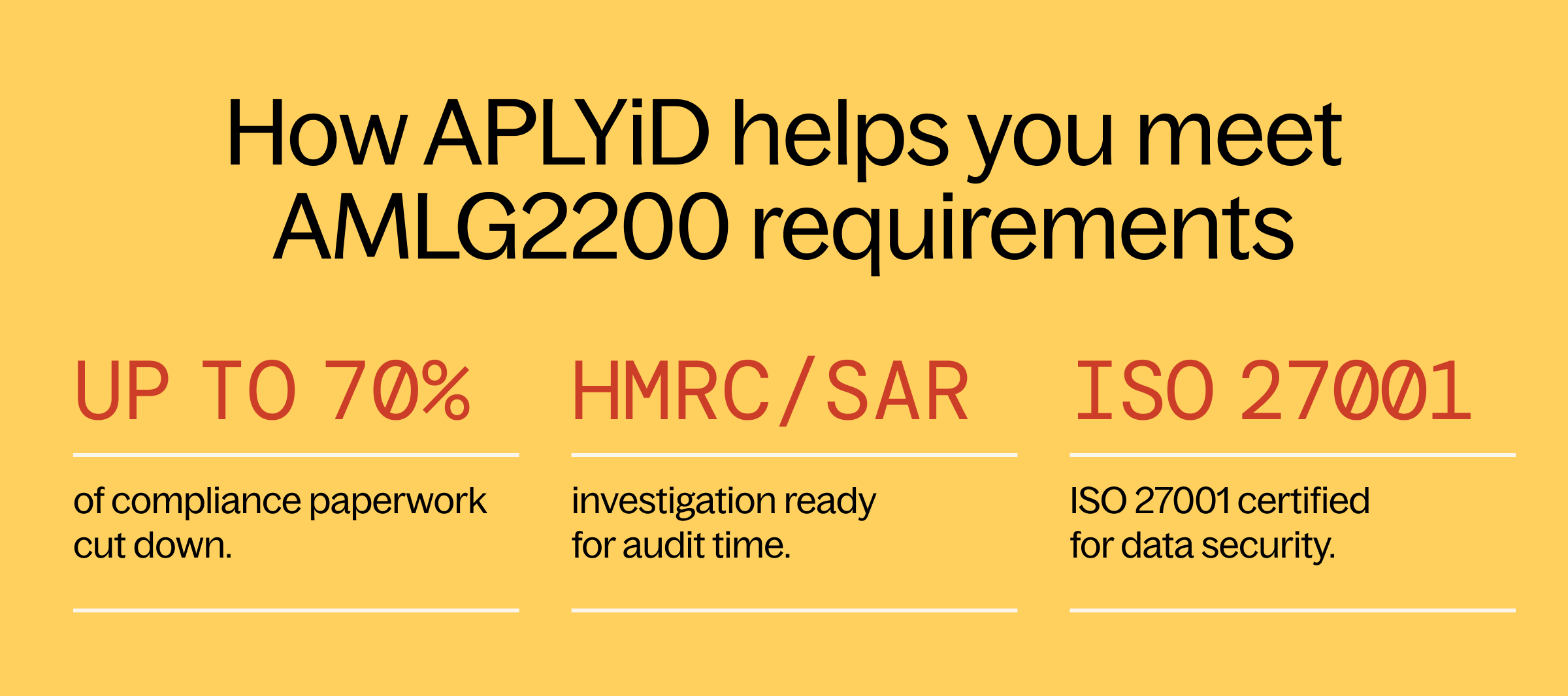
The result: agencies using APLYiD cut compliance paperwork by around 70 percent, and end up with a clean, documented audit trail ready the moment HMRC or a SAR investigation comes calling. APLYiD is ISO 27001 certified, self-serve, and comes with a free trial and real human support when you need it.