Blogs
Real-world AML scenarios: How to handle clients in legal services
Rules and theory are one thing. But when a client's instructions don't quite add up, or a transaction structure raises more questions than answers, you need to know how to respond - not just that 'suspicious activity should be reported'.
Legal professionals handle some of the most complex and high-value transactions in the economy. Under NZ law, that also means carrying some of the most significant AML/CFT obligations in the country. Here's how some common scenarios should be approached.
Scenario 1: The new client with an unusual brief
What's happening
A new client approaches your firm wanting to establish a trust structure to hold a property portfolio. They're vague about the purpose of the trust, aren't able to explain clearly where the funds are coming from, and seem keen to get the structure established quickly. They'vebeen referred by someone you don't know.
Why this matters
Trusts and company structures are legitimately used - but they're also a favoured tool of those seeking to obscure the ownership of assets. When you're helping establish a structure, you need to understand who it's for and why.
What you should do
- Conduct CDD before establishing the client relationship or carrying out captured work.
- Ask about the purpose of the trust and document the explanation
- Ask about the source of funds that will be held in the trust
- Verify the identity of the beneficial owner(s) who will benefit from the structure
- If the client can't or won't explain the purpose clearly, decline to act
Taking on a client you can't verify isn't just a compliance risk - it's a professional risk. Your firm's reputation is on the line as much as your licence.
Scenario 2: Acting on a property transaction with third-party funds
What's happening
You're acting for a buyer in a property purchase. Midway through the transaction, the buyer mentions that the funds are actually coming from an overseas account held by a relative who 'doesn't want to be involved'. The relative isn't named on the purchase contract.
Why this matters
Third-party funding in property transactions - particularly from overseas accounts - is a significant red flag. It may indicate structuring to avoid scrutiny, or that the true purchaser is being deliberately concealed.
What you should do
- Pause the transaction and request full details of the third party
- Verify the identity of the third party
- Ask for documentation on the source of funds from the third party
- Consider whether the ultimate beneficiary of the transaction is the named buyer or someone else
- If the explanation doesn't hold up, file an SMR and reassess whether to continue
Scenario 3: Client funds that don’t add up
What's happening
A client asks you to hold a large sum in your trust account ahead of a proposed business acquisition. When the acquisition falls through, they ask you to send the funds back - but to a different account in a different name to the one they came from.
Why this matters
Using lawyers' trust accounts as a pass-through for funds is a known money laundering technique. The fact that the funds are being returned to a different account - or at all, without a genuine transaction - is a significant indicator.
What you should do
- Do not transfer the funds to a different account without understanding why
- Ask for documentation explaining the discrepancy
- Return funds to the original source account, not to a third party
- Document your reasoning and the steps you've taken
- File an SMR if you suspect the trust account is being used as a laundering mechanism
Your trust account is not a pass-through service. If clients are using it that way, that's a red flag - not a routine transaction.

Scenario 4: The politically exposed person (PEP)
What's happening
A new client discloses, or you discover through research, that they are a senior foreign government official. They're seeking your assistance with a residential property purchase in New Zealand.
Why this matters
Politically Exposed Persons (PEPs) present higher ML/FT risk because of their access to public funds and the potential for corrupt activity. This doesn't mean PEPs are criminals - it means you need to apply additional scrutiny.
What you should do
- Apply enhanced due diligence as a mandatory step
- Seek senior management sign-off before taking on the client
- Establish the source of funds and source of wealth - not just for this transaction, but more broadly
- Monitor the relationship more closely going forward
- Document all of the above thoroughly
Scenario 5: The suspicious instruction you can't explain
What's happening
An existing client gives you an instruction that seems unusual - perhaps structuring a transaction in a way that appears designed to avoid a reporting threshold, or asking you to use nominee arrangements without a clear commercial reason. You don't have direct evidence of wrongdoing, but your gut says something is off.
Why this matters
Legal professionals often operate on instinct built from experience. If something feels wrong, it's worth examining why. 'Structuring' - deliberately breaking transactions into smaller pieces to avoid reporting thresholds - is a criminal offence in itself.
What you should do
- Ask the client to explain the rationale for the proposed structure
- If the explanation isn't credible or forthcoming, don't proceed
- Escalate to your firm's AML/CFT compliance officer
- Consider whether an SMR is required
- Remember: you don't need certainty to file an SMR - suspicion is the threshold
You don't need to prove something is wrong to file an SMR. If you suspect it, and a reasonable person in your position would too - that's enough.
When to file an SAR
The trigger for filing a Suspicious Activity Report is not conviction - it is suspicion. You must file an SAR with the NZ Police Financial Intelligence Unit (FIU), through GoAML, if:
- You suspect on reasonable grounds that a person is not who they claim to be
- The transaction is connected to the proceeds of crime
- The transaction involves financing terrorism
- Filing a report may be relevant to an investigation of a serious offence.
File the report as soon as practicable, no later than 5 working days after suspicion if formed. Once filed, do not tell the subject of the report. Keep the fact and content of the report confidential.
Make sure your team is ready
Knowing what to do in these situations doesn't happen by accident. It happens when your team has been properly trained - and that training is kept up to date.
APLYiD’s end-to-end platform is built to support you at every stage of the process. From tailored risk assessments and CDD checks that catch red flags at onboarding, to ongoing monitoring - we give you the tools to identify and respond to risk at every point in the process."
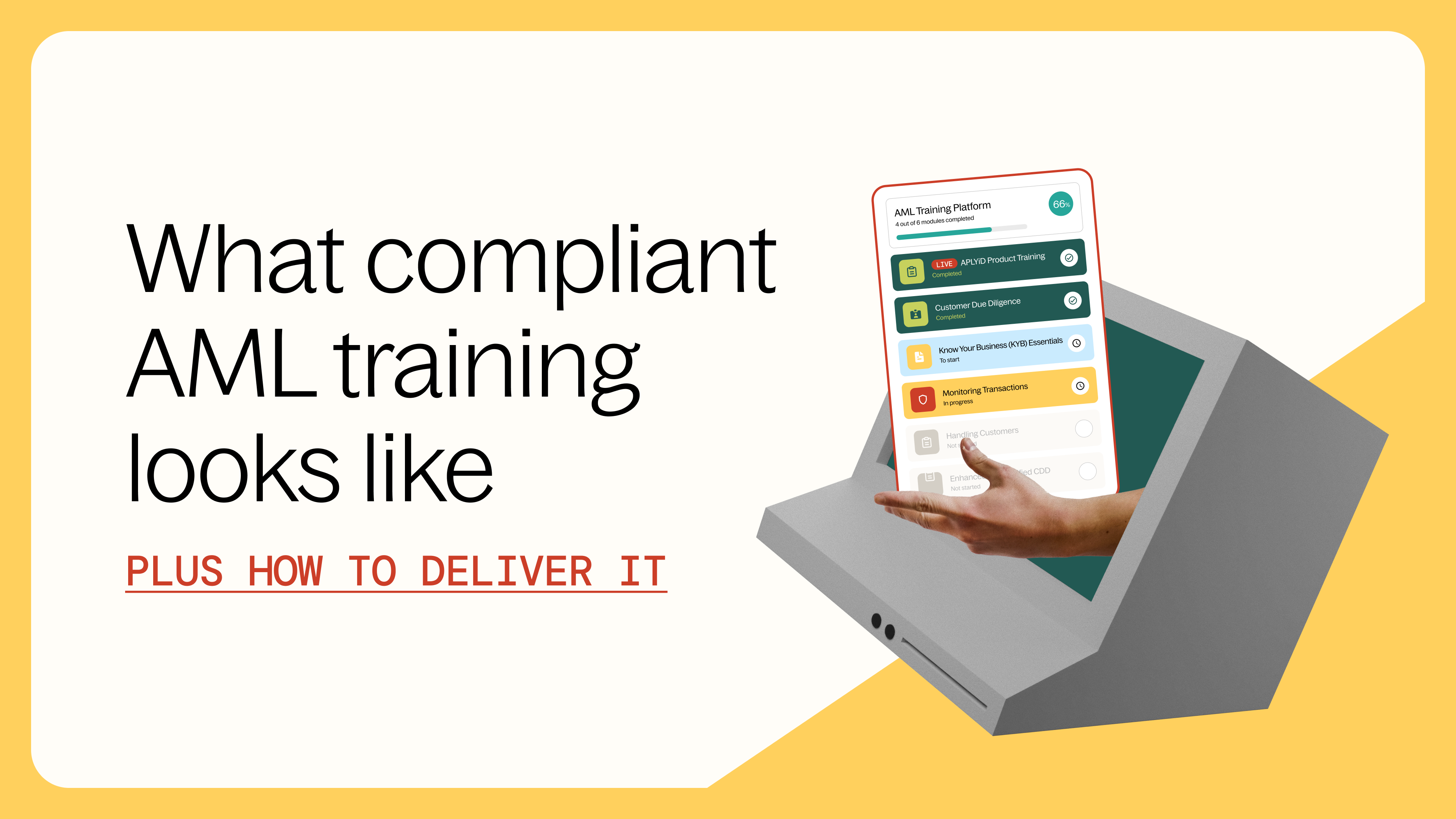
APLYiD's AML training platform gives your legal firm the tools to build a genuinely capable team. Scenario-based courses, quizzes, certifications, and a full learning management system - so you're not just ticking a box, you're actually prepared.