Blogs
Real-world AML scenarios: How to manage risky clients in real estate
When you engage with a client and something feels off, you need to know what to actually do - not just that 'suspicious activity should be reported'.
The Department of Internal Affairs (DIA) has published guidance for real estate agents operating under New Zealand's AML/CFT framework. We've taken that material and turned it into plain-language scenarios your team can use.
Scenario 1: The vendor who cannot explain ownership
What's happening
A vendor wants to list a property held in the name of a company or trust. The person giving instructions cannot clearly show they're authorised to do so, and when you ask about the beneficial owners, the answers are vague or inconsistent.
Why this matters
Under the AML/CFT Act 2009, your CDD obligations apply to the real human beings who ultimately own or control an entity - not just the name on the title. Real estate agents are Designated Non-Financial Businesses and Professions (DNFBPs) under the Act, supervised by DIA. Opaque or shifting ownership information is a red flag in its own right.
What you should do
- Map out the ownership structure and identify the beneficial owners - anyone with 25% or more ownership or control
- Confirm the authority of the person giving instructions with documentation: a trust deed, company register extract, or written authorisation
- Apply EDD if the structure is complex, and escalate to your compliance officer if information is inconsistent or evasive
- If you cannot establish who your client actually is, do not proceed with the listing
Scenario 2: Sale proceeds going to a third party
What's happening
As settlement approaches, someone asks you to direct sale proceeds, a commission refund, or other funds to a third-party account - possibly overseas, possibly in a different name from your verified vendor.
Why this matters
Redirecting funds to unverified third parties is one of the clearest red flags in property transactions. It can facilitate money laundering by inserting a layer of separation between the crime and the clean money. DNFBP-specific wire transfer regulations have also been in force since 31 July 2023, strengthening your obligations around how funds move through your trust account.
What you should do
- Verify any redirect request directly with your client by phone - on a number you already hold, not one provided in the instruction
- Ask for a written, signed instruction and a clear explanation of why funds are going to a third party
- Apply EDD if the account is overseas or in a higher-risk jurisdiction, and do not redirect funds if the explanation doesn't satisfy you
- If the overall picture raises reasonable suspicion, consider filing an SAR with the NZ Police FIU via GoAML - and remember, you cannot tell the client you've done so
Scenario 3: The rushed listing with inconsistent information
What's happening
A vendor is pushing for a quick listing or fast settlement. Their explanation for selling keeps changing, or they can't give a coherent one at all. When you ask for CDD documents, they become evasive or suddenly too busy to respond.
Why this matters
Urgency combined with inconsistency is a common pattern in money laundering scenarios. The goal is to push a transaction through before due diligence can catch up. Your obligations don't shrink because your client is in a hurry - if anything, unexplained urgency is itself a risk indicator.
What you should do
- Continue your standard CDD process regardless of time pressure, and document any inconsistencies you encounter
- Make clear to the client that you cannot proceed until identity verification and CDD requirements are met - the timeline is not negotiable
- Apply EDD if the urgency is combined with other risk indicators such as unusual ownership or offshore elements
- If the overall picture gives you reasonable grounds for suspicion, escalate internally and consider filing an SAR

Scenario 4: The vendor using a nominee or person acting on their behalf
What's happening
A relative, adviser, or 'business partner' is giving all the instructions - but they are not the registered owner of the property. Their authority is undocumented, and the actual vendor has little or no direct involvement.
Why this matters
Nominee arrangements can be used to obscure who is really behind a sale or to distance the true owner from a transaction they may not even know is happening. Under the AML/CFT Act, when someone acts on behalf of a customer, you must verify the identity of both the person giving instructions and the underlying customer. The DIA's guidance on 'Acting on behalf of others' is explicit on this point.
What you should do
- Verify the identity of both the person giving instructions and the registered vendor - they are not interchangeable for CDD purposes
- Require formal documentation of the authority to act: a power of attorney, company resolution, or written authorisation
- Speak directly with the registered owner where possible to confirm they are aware of and consent to the transaction
- If authority cannot be established or the arrangement appears designed to distance the real owner from the transaction, do not accept instructions and consider whether an SAR is warranted
Scenario 5: The overseas vendor or beneficial owner from a higher-risk jurisdiction
What's happening
A vendor wants to list a New Zealand property, but during CDD you find that the vendor, beneficial owner, or a controlling person is based in - or has financial connections to - a jurisdiction with identified AML/CFT deficiencies. They're reluctant to provide ownership information, source of wealth details, or a clear explanation of how they came to own the property.
Why this matters
New Zealand's property market is identified as a vulnerability in the NZ Police FIU's national risk assessment. Overseas ownership from higher-risk jurisdictions is one of the elevated risk factors DIA specifically identifies for real estate agents. Reluctance to explain source of wealth, combined with an offshore connection, warrants EDD as a minimum - not accommodation.
What you should do
- Apply EDD as a baseline and request documentation on both source of funds and source of wealth
- Check the DIA's country risk guidance and current sanctions lists, and seek sign-off from your compliance officer before proceeding
- You are not obligated to act for every client. A polite explanation that the transaction falls outside your current capacity is a legitimate response
- If due diligence cannot give you reasonable comfort, consider filing an SAR with the FIU via goAML
When to file an SAR
The trigger for filing a Suspicious Activity Report is not proof - it is suspicion. Under the AML/CFT Act 2009, you must file an SAR with the NZ Police Financial Intelligence Unit (FIU) if you have reasonable grounds to suspect that a transaction is connected to money laundering, involves the proceeds of crime, or may be relevant to the financing of terrorism.
File through GoAML, the FIU's secure reporting platform. Once filed, do not tell the subject of the report - the tipping off prohibition in section 46 of the Act is absolute and breaching it is a criminal offence. Keep the fact and content of the report confidential.
Make sure your team is ready
Knowing what to do in these situations doesn't happen by accident. It happens when your team has been properly trained - and that training is kept up to date.
APLYiD's end-to-end platform is built to support you at every stage of the process. From tailored risk assessments and CDD checks that catch red flags at onboarding, to ongoing monitoring - we give you the tools to identify and respond to risk at every point in the process.
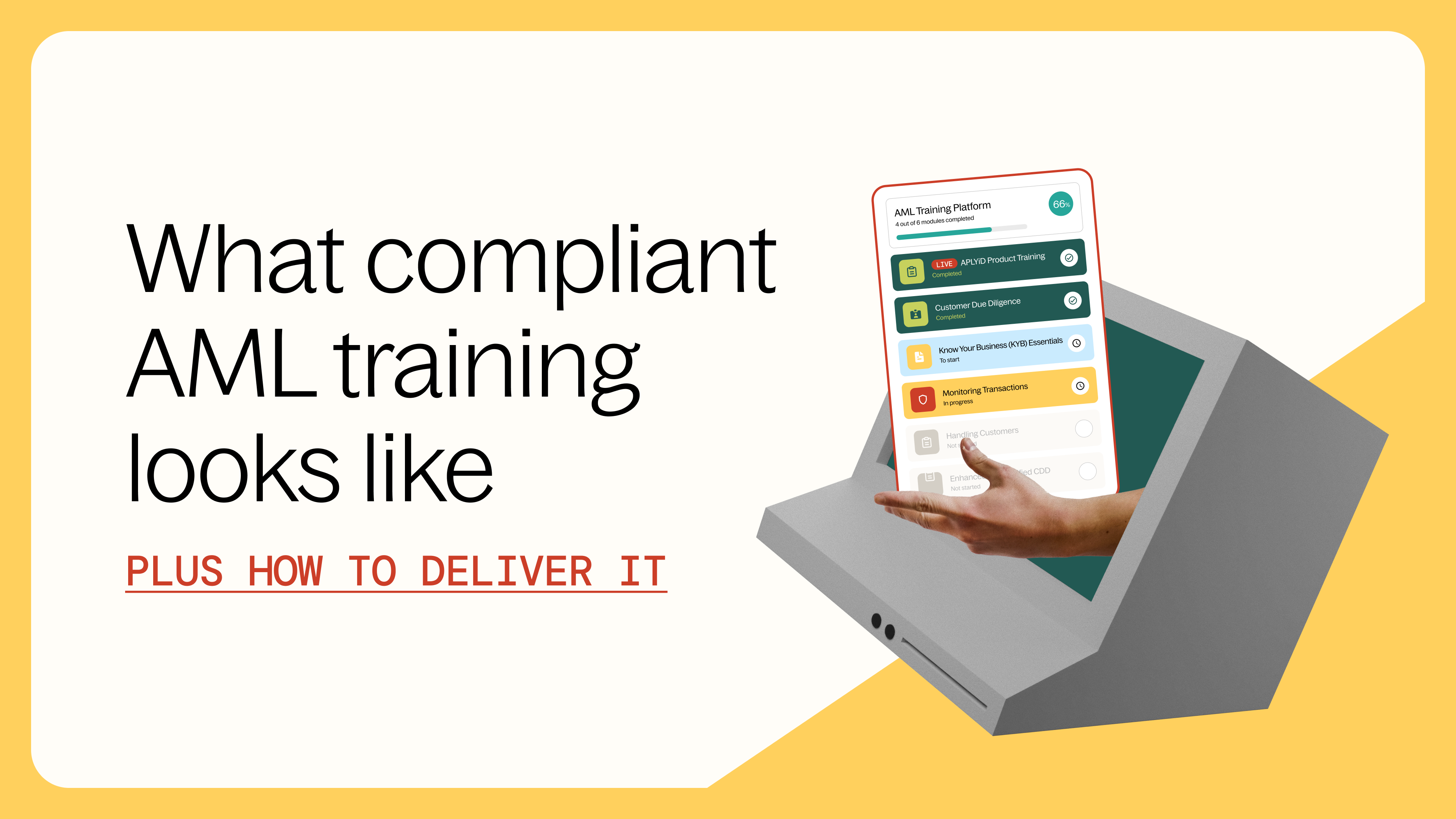
Our AML training platform gives your real estate firm the tools to build a genuinely capable team. Scenario-based courses, quizzes, certifications, and a full learning management system - so you're not just ticking a box, you're actually prepared.