Blogs
New Zealand’s AML/CFT national strategy 2026–2030: What it means for regulated businesses

The New Zealand Government has released its AML/CFT National Strategy for 2026 to 2030, setting out how the country plans to strengthen its approach to tackling money laundering and terrorism financing over the next four years.
For legal, real estate, financial services, accounting, or trust and company service providers, this strategy signals where the AML regime is heading and what regulators want the system to look like in practice.
If you enjoy reading government strategy documents for fun, congratulations. You are a rare breed.
For everyone else, we have done the hard work and pulled out the bits that matter for regulated businesses.
What this document is
The National Strategy is the government’s direction of travel for the AML/CFT regime.
It outlines the priorities regulators and enforcement agencies will focus on between 2026 and 2030, including how they plan to improve the effectiveness of the system and reduce unnecessary complexity for businesses.
The goal is pretty straightforward:
• Make it harder for criminals to move money
• Make compliance easier for legitimate businesses
• Focus effort on real risk, not pointless admin
It’s less about adding new obligations, and more about making the system work better.
The key themes you should know about
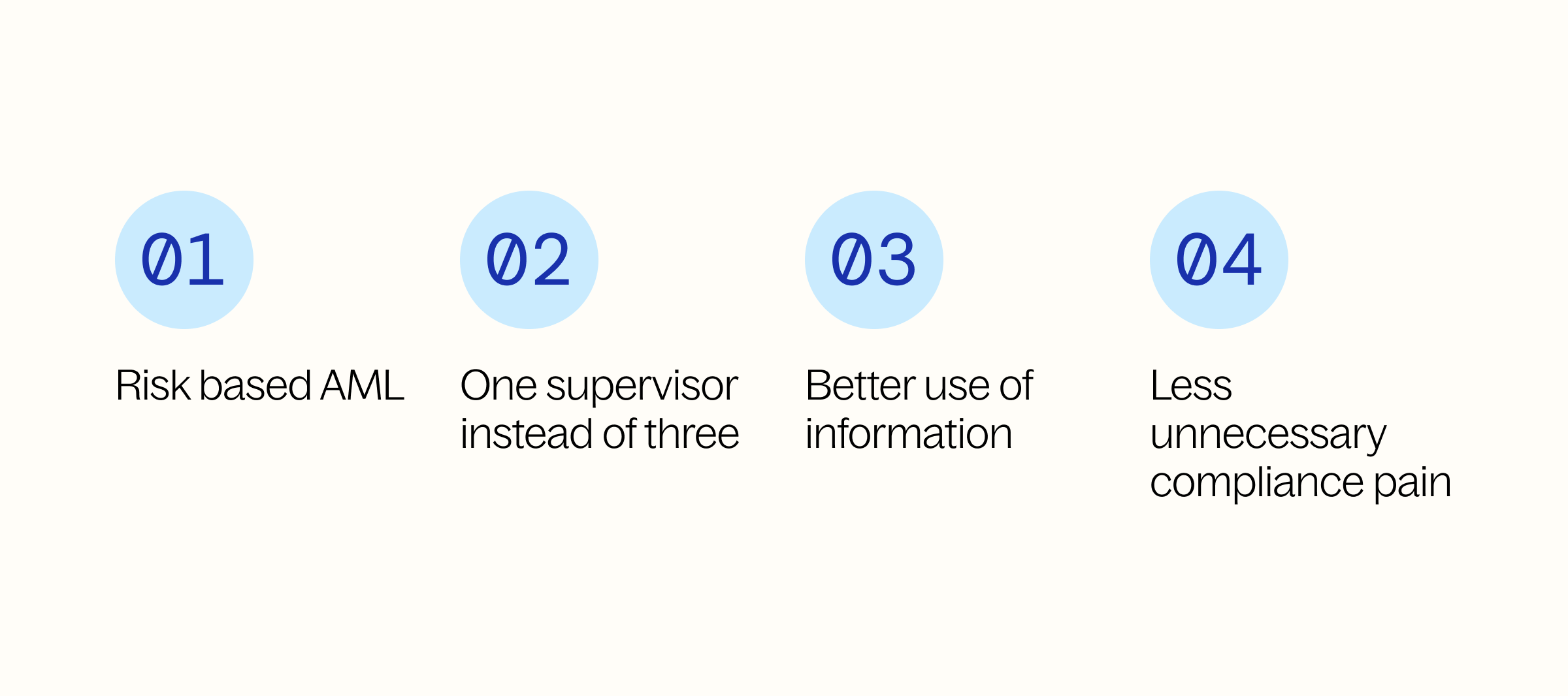
1. Risk based AML
The strategy doubles down on the idea that AML should be risk based. Low-risk customers should not require mountains of paperwork.
Higher risk activity should get the attention it deserves. It sounds obvious, but anyone who has worked with AML processes knows it does not always play out that way in practice.
The goal is to move towards controls that actually detect financial crime.
2. One supervisor instead of three
Right now the AML regime has three supervisors:
- Department of Internal Affairs
- Financial Markets Authority
- Reserve Bank
The strategy confirms plans to move toward a single supervisor under the Department of Internal Affairs (DIA).
Why? Because having multiple regulators can sometimes lead to mixed messages and inconsistent expectations.
A single supervisor should mean clearer guidance and a more consistent approach, which is something most SMEs will happily take.
3. Better use of information
Another focus is making AML reporting actually useful.
That means:
• Better intelligence sharing
• Better use of data and analytics
• Stronger collaboration between regulators and industry
If businesses are doing all this AML work, it should help detect criminal activity, not just fill filing cabinets.
4. Less unnecessary compliance pain
One of the more refreshing themes in the strategy is the acknowledgement that AML compliance can be… a lot.
The government has said the system should protect against financial crime without burying legitimate businesses in admin.
Which is good news for anyone who has ever spent their Friday afternoon chasing a certified passport copy.
What this means for regulated businesses
If you are a law firm, accountant, real estate agency or financial services provider, the direction is clear.
AML compliance is moving toward:
- More risk-based decision making
- Clearer regulatory expectations
- Better use of data and intelligence
- Simpler supervision
But even with those improvements, the core obligations are not going away.
You still need to verify clients, assess risk, monitor activity and keep records that stand up to regulatory scrutiny.
Where APLYiD fits in
This is exactly where APLYiD helps.
Because while strategies and guidance documents are useful, most businesses just want AML compliance to be simple and manageable in practice.
APLYiD brings identity verification, onboarding and AML workflows into one place so businesses can:
- Verify clients in under 90 seconds
- Collect and manage due diligence information in one place
- Keep a clean, shareable audit trail
- Run AML processes without the spreadsheets and email chains
No mountains of paperwork. No compliance chaos. Just a smarter way to get it done.
Because AML compliance should not feel like solving a puzzle every time you onboard a new client.