Blogs
One supervisor to rule them all? What the 2026 AML/CFT shake-up means for regulated entities in New Zealand

If 2025 was about “reviewing the system,” 2026 is about actually doing something about it.
The New Zealand Government has announced a significant overhaul of the AML/CFT regime, including a move to a single supervisor model from 1 July 2026. The Department of Internal Affairs (DIA) will become the sole AML/CFT supervisor, replacing the current three-headed structure of the Reserve Bank (RBNZ), Financial Markets Authority (FMA), and DIA.
In policy terms, this is a big deal. In practical terms, it’s potentially an even bigger one.
Let’s unpack what they’re saying, why it’s happening, and most importantly - what it means for regulated entities on the ground.
What the government is saying
The official message is clear:
- The AML/CFT system needs to be more agile and responsive
- It should be more risk-based, focusing on real threats rather than blanket compliance
- It should reduce unnecessary regulatory burden, particularly where risks are low
- It must still meet international standards
- And it should be funded through a new industry levy model that is equitable and sustainable
Associate Justice Minister Nicole McKee describes the reform as a way to improve efficiency, reduce red tape, and deliver “substantive regulatory relief” while maintaining strong protections against money laundering and terrorism financing.
In short:
Less duplication. More clarity. Better guidance. Smarter enforcement. That’s the promise!
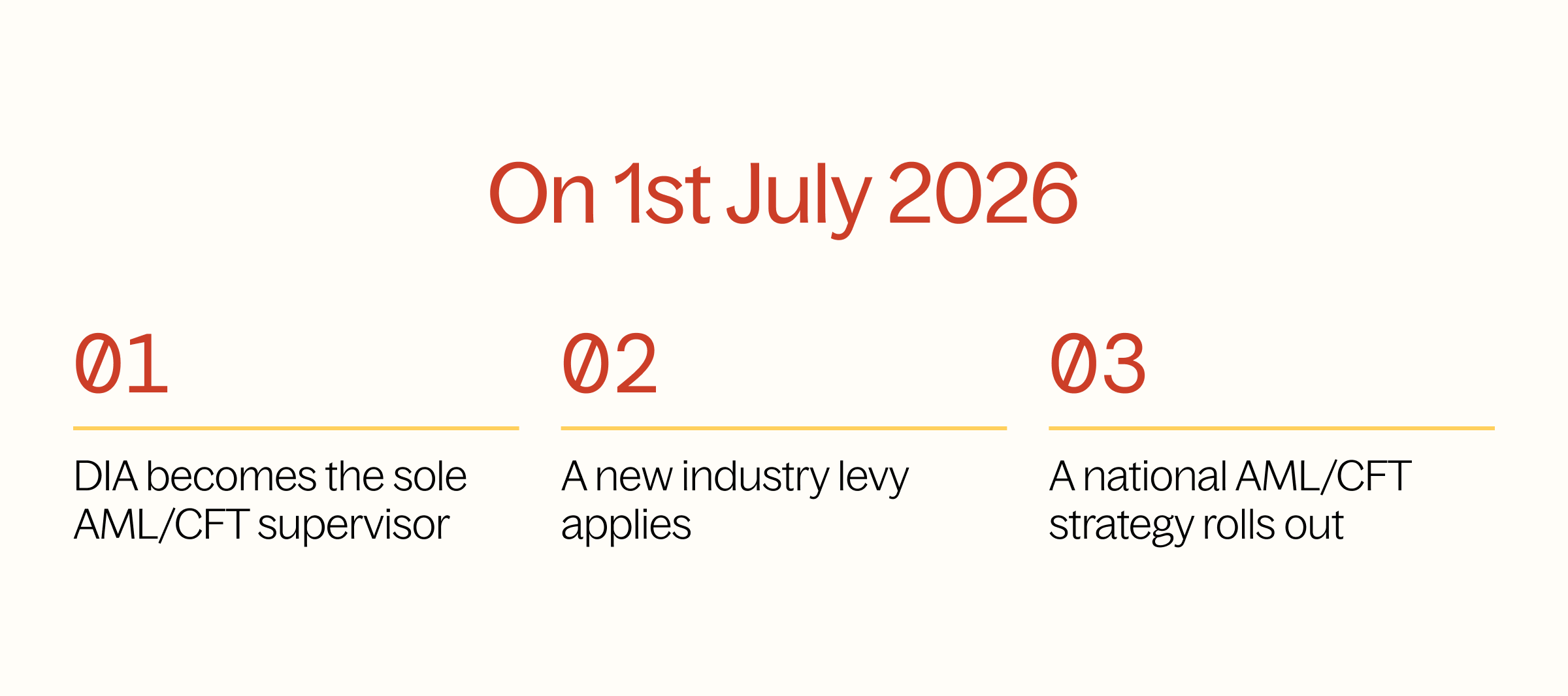
What changes on 1 July 2026?
Here’s what we know:
1. DIA becomes the sole AML/CFT supervisor
All supervision moves under the Department of Internal Affairs.
This means:
- One supervisory approach
- One interpretation framework
- One central point for guidance, codes of practice, and enforcement
In theory, this should create greater consistency and faster development of practical guidance.
2. A new industry levy
Instead of the current funding approach, the AML/CFT system will be supported by an industry levy.
The Government has stated the levy will:
- Be equitable and reasonable
- Avoid placing undue burden on small businesses
- Be tied to the new AML/CFT National Strategy (https://www.justice.govt.nz/justice-sector-policy/key-initiatives/aml-cft/national-strategy-2026-30/) for 2026-2030
The key detail here? Funding changes must be informed by the national strategy. That signals a more structured and transparent link between what industry pays and what it gets in return.
3. A national AML/CFT strategy
The introduction of a National Strategy suggests:
- Clearer priorities
- Defined focus areas
- Potentially better coordination between prevention, supervision, and enforcement
For regulated entities, that could mean clearer direction on what really matters from a risk perspective.
What this means for regulated entities
Now to the practical question: what should businesses expect?
1. More guidance (and hopefully less guesswork)
The Government has emphasised timely guidance and codes of practice. If executed well, this could mean:
- More sector-specific guidance
- Faster updates as risks evolve
- Clearer expectations around risk assessments and customer due diligence
For businesses that have been navigating grey areas with caution (and a mild sense of dread), this could be welcome.
2. A more risk-based approach
The phrase “more risk-based” appears repeatedly in the reform messaging.
In practice, that should mean:
- Less blanket documentation for low-risk customers
- More proportional compliance expectations
- More targeted supervisory activity
- Stronger enforcement where risk is genuinely high
This is good news for businesses that have built thoughtful, risk-based AML frameworks rather than checkbox exercises.
But it’s also a warning: high-risk sectors or weak controls may face sharper, more focused scrutiny.
3. Reduced red tape - but not reduced responsibility
The Government has been explicit that protecting communities and businesses from money laundering harm remains central. The aim is smarter regulation - not softer regulation.
Businesses should expect:
- Continued expectation of robust risk assessments
- Ongoing monitoring and reporting obligations
- Meaningful enforcement where non-compliance is systemic or negligent
If anything, a single supervisor with unified data and oversight could make patterns easier to detect.
4. Potential transitional complexity
Any structural change comes with a bedding-in period. There may be:
- Changes in supervisory contacts
- Updated guidance documents
- Adjustments to reporting processes
- Clarification around levy mechanics
Forward-thinking regulated entities should start planning for the transition now - reviewing internal AML programmes, governance structures, and resourcing.
Because when the system becomes more coordinated, gaps tend to stand out more clearly.
Why this is happening (Hint: FATF was watching)
There are two key drivers behind this reform.
1. FATF evaluation
New Zealand’s AML/CFT regime underwent evaluation in 2020 by the Financial Action Task Force (FATF), the global body that sets AML standards.
Whenever FATF shows up, countries tend to tidy their regulatory house. It’s not just about reputation - poor ratings can affect trade, correspondent banking relationships, and investment flows.
The review highlighted areas where New Zealand could improve effectiveness and alignment with international best practice. That includes making supervision more coordinated and risk-focused.
2. Regulatory fatigue (yes, It’s real)
Let’s be honest: the three-supervisor model has not been famous for simplicity.
- Banks dealt with the RBNZ
- Financial service providers dealt with the FMA
- Lawyers, accountants, real estate agents and others dealt with DIA
- Businesses operating across sectors sometimes dealt with more than one
Different interpretations. Different supervisory styles. Different expectations... That can mean inconsistency, duplication, and uncertainty.
The Government’s reform programme explicitly acknowledges that compliance costs have been overly burdensome in some areas - particularly where risk is lower.
So, the move to a single supervisor is framed as both an efficiency gain and a regulatory relief measure.
So, relief or reform fatigue?
For many regulated entities, the answer may be: both.
There’s cautious optimism in the idea of:
- One supervisor
- Clearer guidance
- A truly risk-based approach
- Reduced compliance friction for low-risk businesses
But there’s also the reality that:
- The bar for effective AML programmes is not lowering
- Enforcement may become more targeted
- Levy funding will need to be factored into budgets
The direction of travel is clear: smarter, more coordinated, more strategic regulation
For regulated entities, the key question isn’t whether AML/CFT remains important - it does. The question is whether your systems are ready for a regime that aims to be both more supportive - and more precise.
Because in 2026, AML compliance in New Zealand isn’t going away - it’s just getting organised.