Blogs
Less burden, more balance: changes to NZ’s Statutes Amendment Act

If you didn’t catch the news last week, the Statutes Amendment Bill passed its final reading and came into effect on 27 November 2025. While the industry wasn’t expecting to see it progress until next year, Parliament has accelerated its passage, and it’s a welcome surprise as this will make onboarding customers even easier for your business.
Among the many small updates, the most meaningful change for AML reporting entities is the amendment to the Anti-Money Laundering and Countering Financing of Terrorism Act 2009 (AML/CFT Act). And it’s a good one.
So, what does this mean for your customer due diligence?
Under the old rules, every customer (no matter their risk profile) required full address verification during CDD. Now:
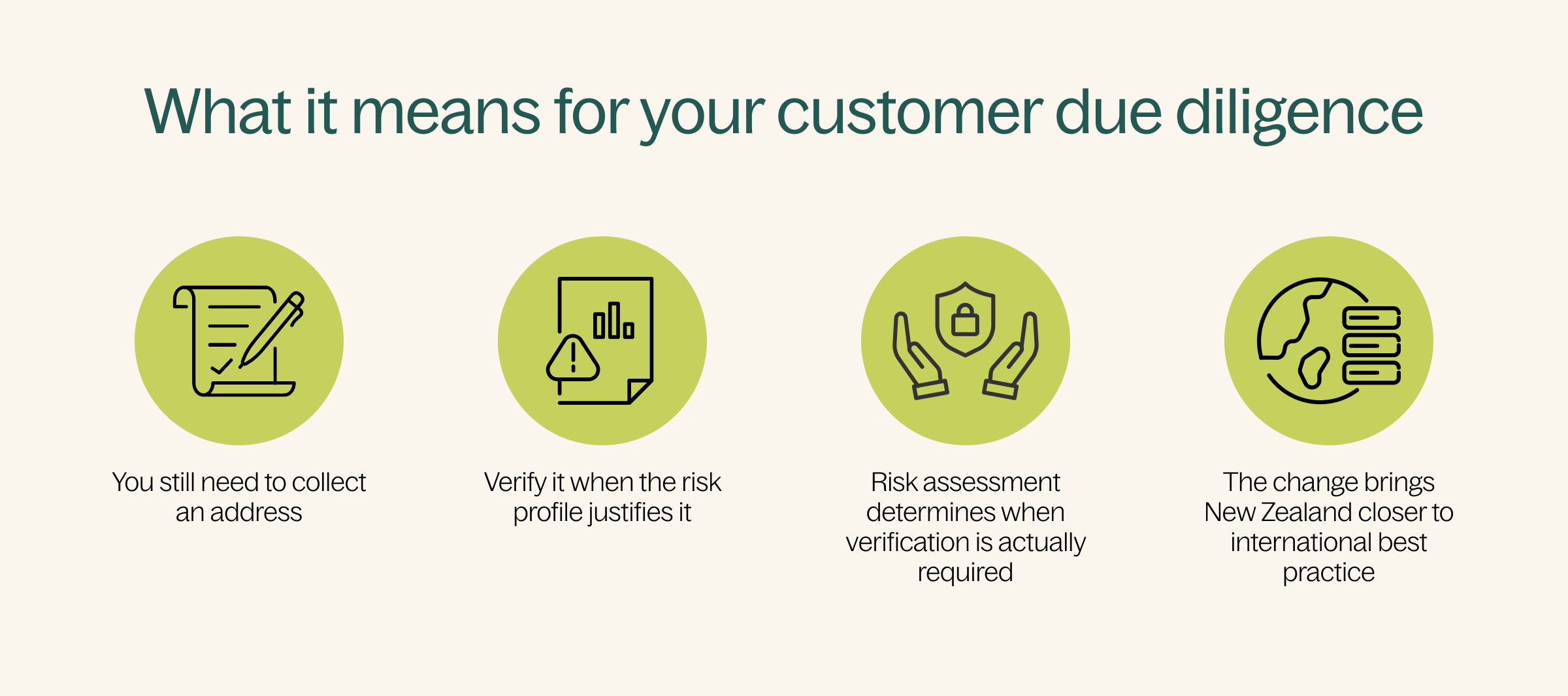
- You still need to collect an address, as part of standard CDD
- But you only need to verify it when the risk profile justifies it
- Your risk assessment now determines when verification is actually required
- The change brings New Zealand closer to international best practice, where obligations are proportional to risk
In short: the rules now match how sensible compliance already should work.
Why this is good news for your business
Relaxing address-verification requirements means:
- Less friction for your customers
- Fewer manual checks for your team
- Faster onboarding - especially for low-risk clients
- Lower drop-off rates
- More time spent on genuine risk, not box-ticking
For small teams, this shift could significantly reduce bottlenecks and free up operational capacity.
What this means for APLYiD customers
As a no-nonsense AML platform built around accuracy, speed and simplicity, this amendment is great news:
- It reduces one of the most time-consuming manual verification steps
- It removes an unnecessary point of failure during onboarding
- And it lets you make even better use of APLYiD’s automated checks, risk assessments, and secure record-keeping
There’s no action required on your side - just keep onboarding as normal. Your compliance decisions stay risk-based, and APLYiD continues doing the heavy lifting in the background.
Updated address-match handling in APLYiD
To align with the DIA’s updated guidance — and remove unnecessary friction during low-risk onboarding — we’ve introduced a new Address Verification setting in APLYiD for New Zealand reporting entities.
What’s changed
APLYiD now gives Company Admins control over how address verification is enforced:
- Addresses are still collected as part of standard CDD
- Address verification is still attempted and recorded
- But when address verification is switched off, a failed match won’t block approval or push a low-risk customer into review
- Where an address is successfully verified, we clearly record this — so it’s available if you need to conduct Enhanced Due Diligence (EDD) later
- The setting defaults to ON, preserving existing behaviour. You can switch it off at any time if that better reflects your risk-based approach.
For higher-risk customers, address verification should remain enabled or be supported with additional documentation. All checks are stored as-is, based on the settings in place at the time, ensuring your records remain complete and audit-ready.
You can expect 50% higher pass rate of your ID checks (rather than being marked as “REVIEW”). This gives you more flexibility, fewer unnecessary declines, and a process that matches the updated regulatory expectation - without losing any of the data you need for ongoing risk assessments.
If you’d like help reviewing your risk-based approach or configuring your workflow for these changes, we’re here to help.
Why the change matters
The government has positioned the amendment as a move toward greater efficiency without compromising AML/CFT safeguards. Their aim: to “provide immediate relief for businesses” while keeping the regime strong and credible.
And for once, that’s exactly what it does.
If you’d like help understanding how this change fits into your risk assessment or onboarding workflow, our team is always here to help.